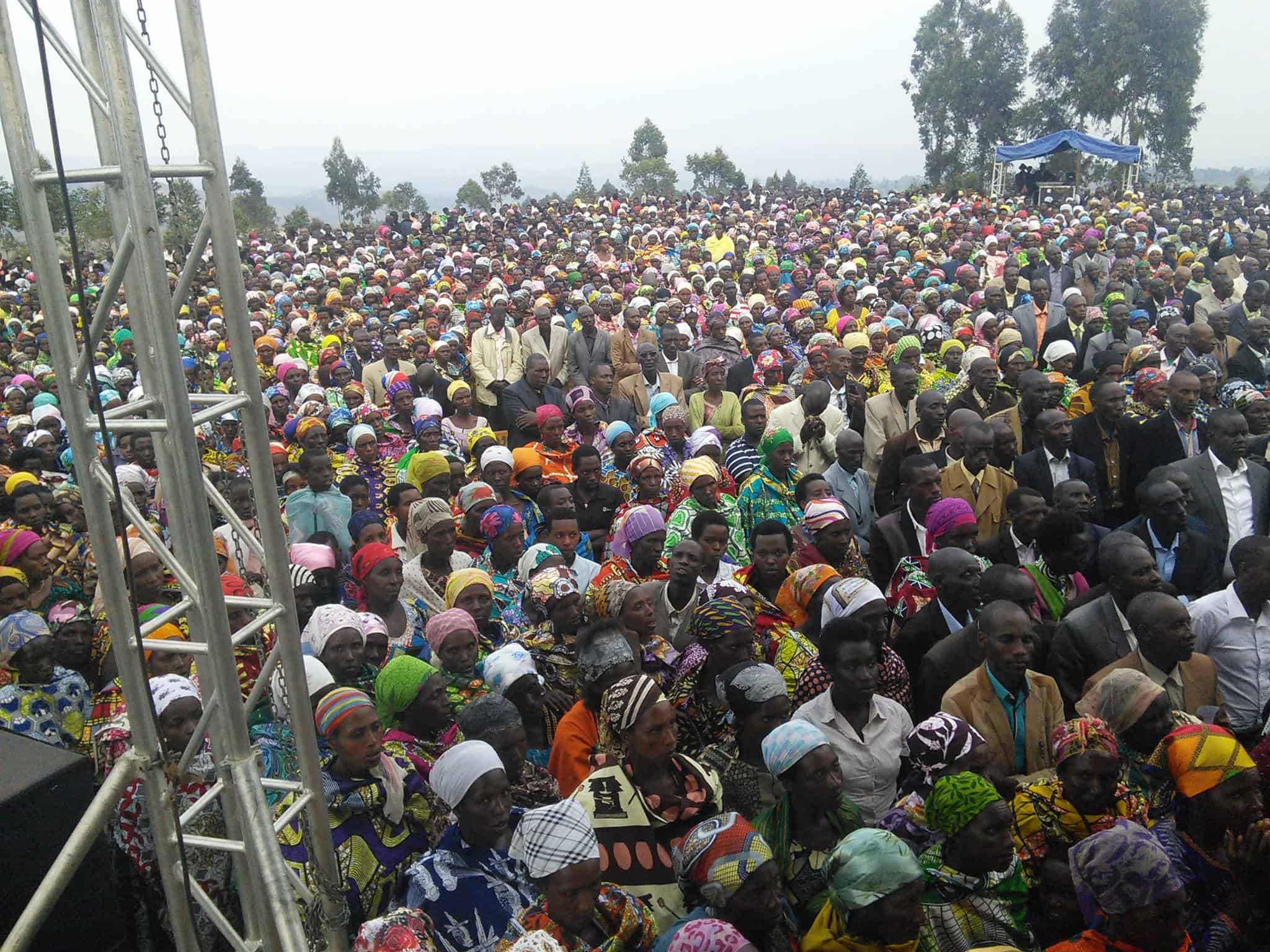
This week, a rebel delegation visited Minembwe, and viral footage is being shared on social media and likely showing local celebrations. The piece cautions against reading these as celebrations and Banyamulenge endorsement of the rebel group. I argue instead that the community has been instrumentalised by all sides. I contend that territorial capture has not lifted the humanitarian blockade, drone strikes are likely to continue unabated, and accountability for crimes remains unaddressed. The central claim is: Banyamulenge are not rebels, and conflating community grievances with rebel-group narratives undermines both their agency and prospects for genuine peace.
1. Rebel delegation to Minembwe
On 07 July 2026, a high-level delegation of the Congolese rebel group from Goma and Bukavu visited Minembwe. The visit followed the regain of control or the capture of some localities around Minembwe, including Point-Zero that previously were held by the Congolese armed forces (FARDC) coalition (MaiMai-Wazalendo and Burundian army). Social media fans and “cyber troops” affiliated to the Congo River Alliance (AFC), Mouvement du 23 Mars (M23), and Mouvement pour la Résistance et la Défense du Peuple (MRDP formerly Twirwaneho) have amplified the capture of these localities and mostly the rebel group visit in Minembwe to mark it as a turning point in their struggle to save Minembwe and the Banyamulenge.
Videos, from Minembwe, shared on social media platforms may misleadingly show types of celebrations. Combatants and civilians came to meet Bertrand Bisimwa and Freddy Kaniki (respectively deputies of Corneille Nangaa) and other members of the delegation that included Bernard Byamungu, the deputy military commander of M23. Local communities have, at some point, been filmed dancing “Igisirimba”[1] in front of the rebel guests. Observed from afar, the celebrations are likely a sign of aligning with or collectively approving the rebel group. Bertrand Bisimwa, one of the rebel leaders who visited local populations, promised that the war around Minembwe had ended.
However, the situation is still uncertain to the extent that celebrating is not yet an option to consider now. A local saying states that “someone who rises from the dead does not despise the sun” (my interpretation). Below is an opinion that grounds its analysis on the current situation and the near-decade experience of violence in Minembwe.
2. Simplified narratives
The recent capture of localities around Minembwe, including Point Zero by M23/AFC and MRDP-Twirwaneho combatants may likely overshadow the acute humanitarian crisis in and around Minembwe. Militarily and politically, the capture of these localities might sound significant for the rebel group and for civilians whose fate was extremely uncertain as attacks perpetrated by a large coalition including militias who actively destroyed everything since 2019) approached their last shield. Against the backdrop of this dynamic context, I am afraid that the dichotomized narratives and war discourses too often conflate territorial control with humanitarian relief, civilians’ protection while they are not the same. This is very pronounced when it comes to conflicts in the High Plateaux of Itombwe, Fizi and Uvira, specifically Minembwe.
For the communities in Minembwe, simplified narratives will possibly blur the path towards long-term peaceful solutions and undermine the understanding of causes of violence in this region. Uncertainties persist — impoverished civilians who have lived under blockade for roughly a decade, who experienced constant threats of aerial attack, and exposed to criminal predation — need sustained solutions, gained not from the barrel of the guns.
3. Humanitarian Blockade
Despite the recent developments, humanitarian blockade in and around Minembwe continues. The capture of Point Zero or Mikenge will not uplift the blockade. Fo years, the blockade is purposely imposed and stretches from the Ruzizi Plain, Uvira, Baraka, and Fizi. In recent months, it has included aerial blockade that cannot simply be removed by military power of controlling Point Zero. The region stretching from Ruzizi Plain, Uvira, Baraka, and Fizi towards Maniema has for years been cut off. The supply routes are restricted to people based on their ethnic affiliation, specifically the Banyamulenge. This has deepened food insecurity for the population of Minembwe and its surroundings who have experienced impoverishment. It remains firmly in place and won’t be lifted now that Point Zero has been occupied by the rebel groups.
For communities in and around Minembwe, the more pressing question is not who now controls which locality or a strategic hilltop. Their main request, regardless of anyone political and economic interests, is whether the humanitarian catastrophe surrounding them will finally end. If the blockade is to be lifted, it will require a deliberate and verifiable process that involves humanitarian organisations, key regional actors and belligerents to commit themselves to comply with the international humanitarian laws.
4. Drones strike & technological warfare
The same logic applies to the drone strikes that have punctuated the conflict in recent months. The dynamics and developments of warfare in the eastern DRC is the use of technological weaponry, including the use of drones’ strike in densely populated areas.
As I share this opinion, we are amid of intense military confrontations in and around Minembwe that involve regional countries, Congo, Burundi and Rwanda. Next to ground warfare, drone strikes are carried out from multiple, geographically dispersed points, under what appear to coordinated chains of command from the military units operating on the ground. With the occupation of Point Zero or other localities around it, will the drone strikes launch from Kisangani, Kamembe, Bujumbura, and Kalemie also stop? This was feedback to one of the comments raised on the “Point-Zero, Bataille Médiatique”.
There are reasons to believe that the occupation of localities inclusisng Point Zero would not interrupt operations coordinated from cities hundreds of kilometres away, including the battlefield on the ground. The drones’ attacks affect civilians as they have become target and victims of military confrontations. There should be mechanisms to protect civilians, prohibit the use of drones in densely populated areas. Prohibit the use of drones should be included in the compliance with humanitarian laws in Eastern Congo, and South Kivu particularly.
5. Crimes and accountability
Protecting civilians should be accompanied by accountability and justice. In an interesting argument that claimed the strategic position of Point Zero, Michel stated righty that it has become “a shelter for those accused of crimes – stealing Banyamulenge cattle”. His comment raised the issue of criminality and accountability that needs attention beyond Point Zero to cover several perpetrators.
In this opinion, I claim again that sustained peace requires accountability and justice. Certainly, Point Zero had become a refuge for perpetrators who have committed violence and ethnic targeting of civilians in South Kivu. However, they are everywhere in the region, and some of them play an indirect role though their responsibilities are enormous. They hide behind the use of guns and can manipulate the socio-security context and the vulnerabilities for their political and economic gains.
6. Banyamulenge are not rebels
Finally, the Banyamulenge are not rebels. They have never chosen to collectively align with any political parties nor any rebel groups. For being a contested community, they chose to resort to different means to survive in a hostile regional setting. For being between the hammer and anvil, they chose resilience and fight for their own survival even when they must confront Congolese armed forces (FARDC), Burundian army (FDNB), and Rwandan-backed foreign militias and local armed groups. I can confidently state that the survival of local communities has nothing to do with M23, nor with Nangaa, Bisimwa or Kaniki. When they fend for themselves, the international community, namely the United States as mediator between DRC and Rwanda should revise its approach to give voice to communities. Conflating the Banyamulenge community grievances into rebel groups claims has had limitations and it sets precedent for instrumentalising grounded grievances.
Conclusion
Beyond emotional attitudes and subjective interpretations, Minembwe is not endorsing the rebellion. Local communities, under constant attacks for nearly a decade now, have experienced destruction, devastation and impoverishment, and an imposed siege. At this specific point in time, when violence has devastated and torn apart families, they cannot celebrate due to uncertainties, fresh wounds from the destruction and hundreds of life-threatening injuries whose only dedication and commitment were to save and protect the lives of their relatives.
The Sixth Joint Oversight Committee for the Peace Agreement Between the Democratic Republic of the Congo and the Republic of Rwanda, called for a de-escalation in Minembwe. Specifically, the statement called the DRC and Rwanda to “de-escalate tensions immediately, especially around Minembwe, and to use their respective influence with all parties on the ground to achieve this aim.” Instead of de-escalating, the security situation is becoming volatile, unpredictable, and belligerents are likely mobilising resources and combatants to continue fighting. Hence, civilians are likely to experience prolonged humanitarian blockade.
Until humanitarian corridors are demonstrably reopened, until drone strikes from all points cease — not just those attributed to Point Zero — and until the networks that sustain all criminal activities across the region are meaningfully addressed, the population of Minembwe has little reason to believe in the end of the war and the opening a new peace page.
Delphin Ntanyoma
[1] Igisirimba is a type of worship dance that is mostly used in Christian churches, and it was popularised by Banyamulenge across the globe.
Leave a Reply