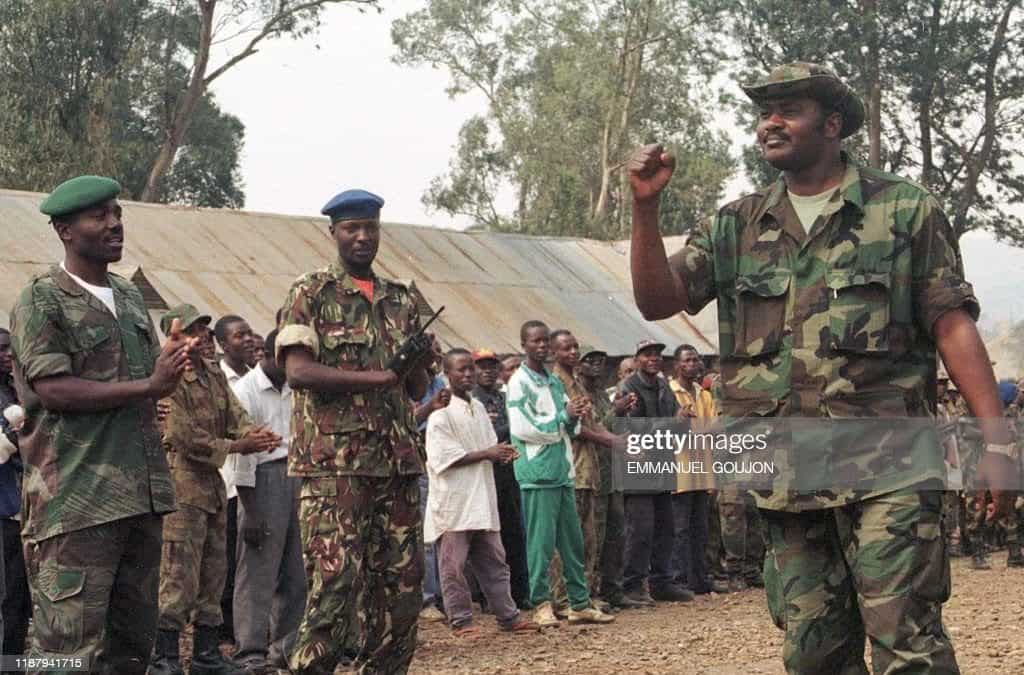
In this argument, I analyse the multidirectionality of violence and the collective attribution of Banyamulenge soldiers discussed in the book “The Banyamulenge Soldier: Genocide between Congo and Rwanda”, published by the University of Michigan Press.
Davey, the author, has written on the Banyamulenge soldiers (see Owing Genocide and Banyamulenge soldiers’ masculinity, for instance), and he uses a multidirectional violence perspective. Using a “multidirectional violence” framework, Davey aims to explicitly challenge mono-causal blame and argues that the Banyamulenge cannot be perceived as ‘mere’ victims; from this angle, he shows them as perpetrators of violence.
In his book, Davey looks at the agency and responsibility of Banyamulenge soldiers in committing violence against their neighbouring communities; implying that members of this community cannot be perceived as victims. Davey’s substantive academic contribution intends to stand as a corrective work of existing scholarship and what is called “advocacy-oriented research”, as he claims. Questioning existing scholarship, mostly books written by Banyamulenge, Davey (p. 41) claims that “their [Banyamulenge] military role is generally subsumed into experiences in victimhood, while questions of perpetration are left unanswered.” Thus, his contribution “bridges this gap in (re)analyzing these accounts and soldier interviews.” A quick glance of Davey’s book shows that there are some aspects worth flagging up for future enquiries into victim-perpetrator perspective:
1. Methodological shortfalls
The aim and intention of the book were academically relevant. However, Davey’s methodology raises questions about a sampling that may suffer from a selection bias. First, the research interviewed active and former combatants as well as “political actors” (p.43). Bridging the gap to understand victim-perpetrator relationship within a single community would require interviewing ordinary people, namely civilians whose perceptions had not been shaped and influenced by political indoctrination or trajectories.
Second, participants’ views are analysed in isolation from opposing groups’ perspectives. Participants are collectively characterised as “self-exculpatory” while there was no comparative sample. To understand Banyamulenge soldiers’ subjectivities, the study would have included a comparison group (soldiers and political actors) from neighbouring communities. The selection bias and lack of a comparative group had inevitably induced the author to inflate Banyamulenge soldiers’ tendency to downplay their “perpetration responsibilities”. I believe that if the author had included a good number of MaiMai Yakutumba’s combatants and political actors affiliated to the Babembe community in his analysis, he would have captured the degree of empathy reduction and competitive victimhood when community members operate in a polarised and fragile context.
Third, the research interviewed soldiers as individuals with distinct trajectories. They are not a single entity. The author acknowledges that Banyamulenge soldiers have had different perceptions and choices when it came to join armed rebellions in eastern DRC. The author recognises that some of them had even mutinied against these rebellions. Yet, the discussion presents “Banyamulenge soldiers” as an aggregate actor rather than through named units, commanders, or factions. It concludes by assigning a collective responsibility that justify atrocities and violence against civilians.
Fourth, Davey’s research is not the source of new factual findings and evidence about who committed massacres in eastern Congo and the specific role of Banyamulenge soldiers. His contribution comes from synthesizing and paraphrasing findings that already existed. While some of them such the Human Rights Watch referred to “RCD forces and their backers“, Davey’s framing assigns responsibilities, reframed to collectively blame soldiers who belong to an entire ethnic community. The collectivizing language isn’t the residue of independent research that happened to implicate the community — it’s an editorial choice made while condensing sources that themselves were often more careful about distinguishing individual, unit, and institutional responsibility from ethnic identity.
Fifth, the author interrogates credibility and neutrality based on who is making the claim more than how well-sourced the claim is. Official Rwandan/RPF statements get treated as self-interested (fair). Western scholarship, NGOs and human-rights reporting get treated as neutral bedrock (largely unexamined). Banyamulenge diaspora advocacy and scholarship get named, singled out, and subjected to a “reliance on one perspective” critique that several of his own most strong citations would fail if applied evenly.
Furthermore, the author chooses an upper endpoint when validating massacres allegedly committed by the Banyamulenge soldiers and uses a lower endpoint when describing atrocities committed against the Banyamulenge. In Makobola (500 as per New Humanitarian or UN Human Righs Office) and Kasika (at least several hundred as per HRW and other report), Davey cites 800 and more than thousands respectively (p.167). However, some sources describing the Bibokoboko (Bibogobogo) situation in October 2021 (Radio Okapi and Journal of Political Risk) cited a dozen villages and approximately 8000 displaced, Davey chose a “more modest estimate based on the sources,” 1200 displaced and 2 villages burnt down (p.212-13). Twenty-eight years after Kasika and Makobola massacres and following the Kipupu massacre (2021), the academic world and Congolese society would welcome new evidence identifying those responsible.
Sixth, Davey’s research tends to implicitly admit that Banyamulenge civilians or/and unarmed soldiers were targeted because of their collective responsibility as perpetrators. Yet, it appears that his research did not extensively assess what happened in Lubumbashi, Kasai, Kamina, Kalemie, Vyura, Kinshasa, Moba… to name but few sites where the Banyamulenge, Tutsi and others were killed based on their physical appearances. When his participants claim that they were “powerlessness, low rank, low education, to justify retaliation as convenient narrative that minimises their agency and responsibilities, Davey rightly call for deserved interrogation rather than acceptance at face value. Nonetheless, the author fails to apply the same logic when it comes to atrocities committed against the Banyamulenge. The logic is only loosely applied on Gatumba massacre, the case Davey has extensively studied.
2. Collective attribution of perpetration
In his book, Davey portrays the “Banyamulenge soldiers” as the default grammatical subject of atrocity. For instance, in the Makobola/Kasika massacre, the RCD’s 1998–99 killings are narrated with “Banyamulenge soldiers… were involved in massacres,” (p.166). Davey claims that “Banyamulenge soldiers filled the ranks and also populated the targeted areas along with other Congolese groups such as the Babembe population in Makobola.” The author does not specify how many were they, or whether this group was a mono-ethnic and in which military structure they operated. The book does not state a clear role played by Banyamulenge soldiers and that of RCD rebel military and political officials. The role of Rwandan and possibly Burundian troops that operated in this region is subsumed in the collective Banyamulenge soldiers’ label. How was the order of killing was given is unclear as one may think that soldiers were accountable to a “Banyamulenge structure” within the RCD.
In the same vein, Davey claims that “the same contingent of RCD soldiers… raped and killed civilians in Kasika” (p.167). Davey seems interchangeably using RCD’s contingent and Banyamulenge soldiers. In this book, the number of military units involved in Kasika is not clearly stated and only one individual is named — Pacifique Masunzu, as overseeing commander. While Pacifique Masunzu is a member of the Banyamulenge community, his position is not clearly determined in this book that aims at correcting existing literature. It has been proven that Pacifique Masunzu was in Uvira in August 1998 not in Kasika.
From this reading, Davey attributes responsibility compounded in the ethnonym as collective “Banyamulenge soldiers,” “Banyamulenge RCD soldiers” rather than with the RCD as a multi-ethnic, Rwandan-officered military structure with multiple Rwanda Defense Forces’ commanders such as Kabarebe, Dan Gapfizi, Lt Murangira, Lt Rugangazi… who were actively involved in the RCD chain of command in Uvira. The author dismisses the fact that the RCD army included non-Banyamulenge Congolese officers and rank and file soldiers, and some of them played a prominent role in the rebellion. Will their responsibility be assessed if their relatives are targeted?
3. The stereotype is named and replicated.
Davey writes that the memories of Makobola and Kasika “feed into the stereotype of Congolese Tutsi as exploitive and as the authors of massacres throughout recent history” (p.167). Davey flags such conceptualisation as a stereotype, and he is more aware such (mis)perceptions are common across different socio-security settings in conflict zones. However, naming a stereotype isn’t the same as declining to reproduce its logic. Throughout the book, the broad logic can be interpreted as he still uses “Banyamulenge soldiers” as the operative unit of agency rather than the specific AFDL groups, RCD soldiers or units, or commanders responsible, which is exactly the substitution of individual/unit versus “ethnic collective” that generates the stereotype in the first place.
4. Strong and unsubstantiated claims
The book contains strong and unsubstantiated claims. For instance, Banyamulenge authors are portrayed as part of a “narrative network” while their books are presented as intending to craft a “genocide narrative”. The way the author came to this conclusion, methodologically, is unclear; unless it is based on his commonsense. Genocide Watch (GW) is (mis)represented as “relied solely on single sources and perspective, [and] replicating many of the historic FRF grievances and obfuscating the role of Banyamulenge armed actors in the region”.
The clear connection between FRF’s historic grievances around territorial governance and the need of establishing a federal system in DRC with GW research is controversial. Davey believes that establishing a federal form of governance equals creating a “ Haut Plateaux could become a state within the state” (p.190). Such an unsubstantiated claim may raise local suspicions and would be associated with risks of misinterpretations. Based on conversations I had with the author and former FRF’s political figures, this is an unsubstantiated claim.
Moreover, the author states that Ntanyoma’s work on slow genocide targeting the Banyamulenge is an “exclusivist tool in constructing a victimhood drained of agency” (p.219). I suggest that both articles “expressive violence and the slow genocide of the Banyamulenge in South Kivu” and “under the shadow of violence: are the Banyamulenge experiencing a slow genocide” openly stipulate that individual Banyamulenge soldiers have partaken in violence and massacres against civilians and the Hutu refugees in eastern Congo (see respectively p.381 and p.1295). The scholarship argues that Banyamulenge civilians as a community are primarily targeted based on how they are perceived as “invaders” who are not entitled to live as Congolese citizens in the DRC. It is unsubstantiated to claim that the work is a victimhood exclusivist tool drained of Banyamulenge soldiers’ agency.
Conclusion
Davey’s “multidirectional violence” framework sets out to correct a scholarship it sees as overwhelmingly victim centred and forgetful of the perpetration side. However, the analysis of this book shows that the corrective approach is methodologically and analytically uneven. I identified four shortfalls that needs to be flagged up: (1) the sampling design relies on Banyamulenge combatants and political actors alone, without a comparative group from neighbouring communities. Thus, the sampling process informs and amplify the “self-exculpatory” findings; (2) a persistent collapsing of individual soldiers, units, and commanders into the single ethnonym “Banyamulenge soldiers,” obscures AFDL and RCD’s rebellions that comprised multi-ethnic combatants, and Rwandan-officered command structure.
Additionally, (3) the lack of new facts and evidence makes the book relies selectively on existing reports and scholarship. Subsequently, rather than dismantling the ethnic-collective-blame stereotype the book claims to name and challenge, it likely reproduces it. (4) the discriminating selection of who is credible or not leads the author questions and posits strong and unsubstantiated claims that needed to be crosschecked.
Therefore, a genuinely multidirectional account of violence in this context would require an extensive enquiry into the massacres perpetrated in eastern Congo and South Kivu particularly. The design would aim to identify and name specific units, commanders, and chains of command as well as understanding if massacres were carried out across different ethnic groups including the Banyamulenge.
Delphin R. Ntanyoma
Twitter: https://x.com/Delphino12
Leave a Reply