In autumn 2020, the Institute of Social Studies (Netherlands) and the Conflict and Resilience Research Institute in Winnipeg (Canada) organised a seminar series to delve into the Rohingyas and Banyamulenge’s experiences. The seminar series took place amid huge destruction in the Hauts Plateaux of Minembwe, Fizi and Uvira, South Kivu in the Democratic Republic of Congo (DRC).
The seminar series was organised in four webinars hosted by the Conflict and Resilience Research Institute. The seminar brought researchers, human rights advocates and diaspora activists together to compare the persecution of the Banyamulenge of eastern DRC and the Rohingya of Myanmar.
(2) The Banyamulenge Genocide in Perspective panel:
1. Ahmed Kawser (The Phenomenon of Unwanted Peoples: The Case of the Rohingya Genocide)
2. @Delphino12 (The Targeting and Destruction of an Unwanted People: An Analysis of the Banyamulenge Genocide in DR Congo. Thx @ShacklockTom— Delphin R. Ntanyoma (@Delphino12) June 10, 2023
The series’ theme was titled “Unwanted Peoples and Boundaries of Citizenship Struggles: Banyamulenge and Rohingyas” and the discussion focused on understanding “What happens when a state and its society decide that a community belong nowhere?”
Series focus
Part two (Humanitarian crises and civilian protection): https://www.youtube.com/watch?v=nB71Q-Hji1c
Part three (Collective Victimization, Justice Failures and Learning from the Past): https://www.youtube.com/watch?v=mmjd8IuxbGQ
Part four (Diaspora and Future of Minority Groups: What can be done?): https://www.youtube.com/watch?v=goiOrOdDm3Q
Rohingyas & Banyamulenge Similarities
The parallels between Rohingyas and Banyamulenge are hard to dismiss.
Contested citizenship: In both cases, the central accusation is that the communities do not belong to their home countries. Both groups are labelled non-native, despite having lived in their homeland for many generations. For the Rohingya, this took legal form in Myanmar’s 1982 Citizenship Law, which left them off the list of recognised national groups. Similarly, the Banyamulenge were stripped of citizenship in 1982. Though the 2006 DRC constitution has incorporated some positive changes, the Banyamulenge are still perceived as “foreigners” or “invaders”. Questioning citizenship is not a simple legal debate; it has paved the way for persistent violence.
Dehumanising campaigns: Both are insulted with dehumanising language, called “vermin or scum”. Rohingyas and Banyamulenge endure extreme hate speech and campaigns that have been amplified by the use and accessibility of technology and social media. Beyond dehumanising them, political discourse and narratives portray Rohingyas and Banyamulenge as threats to the state’s security. Presenting a vulnerable minority as a threat makes violence against it easier to justify.
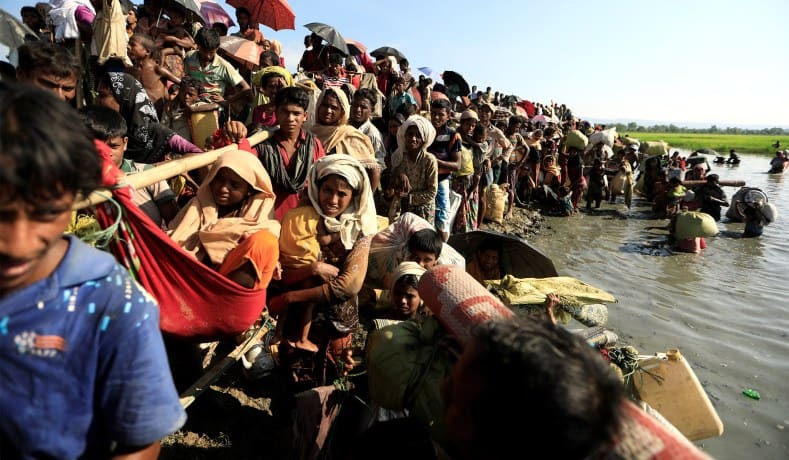
Deprived and under siege: For both Rohingyas and Banyamulenge, recent violence erupted around 2017. Once a people are declared foreign, violence against them can be dismissed as ordinary “inter-community clashes”. Moreover, their vulnerability is denied rather than acknowledged. The Banyamulenge have been impoverished, their livelihoods annihilated, besieged and starved, and their villages destroyed since 2017. From 2024 onwards, the Banyamulenge in South Kivu are under a humanitarian blockade coupled with regular drone strikes. Many have fled their home DRC towards neighbouring countries with no hope to return in their homeland.
The Rohingya have likewise faced confinement, restrictions on movement and the destruction of their means of living. Hundreds of thousands have fled en mass to Bangladesh in 2017. They have been deprived of land ownership and access to work, markets and farmland, leaving most of them with little means of earning a living and heavily dependent on humanitarian aid.
Erasing evidence of attacks: In Myanmar as well as in Congo, authorities have denied the vulnerability of Rohingyas and Banyamulenge. Targeted violence against those perceived as “foreigners” is simplified into “inter-ethnic clashes” to hide state authorities’ and security forces’ responsibilities. Evidence of targeted attacks is erased or destroyed for the sake of dismissing their vulnerabilities.
Recent developments and gaps
The comparison does not claim that both cases are equivalent. Each case has its own history, its own state and its own regional politics. The Rohingya crisis, whatever its failures of response, has entered the global debate.
Following the recent ruling of the International Court of Justice (ICJ) that acknowledged that Myanmar has committed genocide against Rohingyas, this comparison should be pushed further to prevent and save lives of those under constant attacks. The ICJ ruling will possibly invite the international community to pay more attention to the situation of Rohingyas in Bangladesh and all over the world.
Nevertheless, the Banyamulenge remain largely unknown beyond specialists and their own community. Despite what they have experienced for decades and the current extreme humanitarian crisis in South Kivu, the international community still sees the crisis as a peripheral issue to be compounded in efforts to resolve Congo and Rwanda’s conflict. While the regional conflict requires more attention and has implications for the security of minorities, specific attention to violence targeting “invaders” is highly needed.
Lessons to learn
The compaison between Rohingyas and Banyamulenge opens a broad spectrum to understand violence patterns if stoked by the state. As the case of Rohingyas shows, it shows that what is happening in South Kivu follows a recognisable pattern: denial of belonging, hate speech, dehumanisation, then violence. Patterns are identifiable, and what is identified can be interrupted. It needs to document and break that patterns. The Banyamulenge, like the Rohingya, are not unwanted people. They are people whose rights are being denied.
Delphin Ntanyoma
Eastern Congo Tribune
Leave a Reply