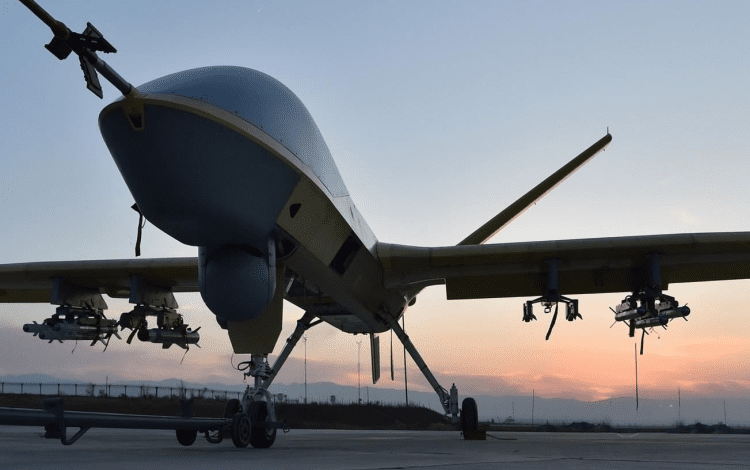
On the 11th of March 2026, drone strikes hit the city of Goma, the first reported drone strike in the city since it fell under AFC/M23 control in 2025. The strike happened in unclear circumstances (requiring further independent investigation) and killed at least three people, including Karine Buisset, a French citizen working for the United Nations Children’s Fund (UNICEF). The attack highlighted the growing use of technological warfare and drones in eastern Democratic Republic of Congo.
The attack triggered a huge condemnation from international leaders and organisations, including French President Emmanuel Macron, the United Nations, and UNICEF Executive Director, who called for respect of international humanitarian law and the protection of aid workers.
Will today’s Goma strike draw attention to the ongoing technological warfare in remote Eastern Congo localities, away from international media and cameras, while attacks have constantly affected civilian populations?
In the DR Congo, a new escalation of violence in Goma has tragically resulted in the death of one of our UNICEF colleagues.
We, along with UNICEF, extend our deepest condolences to her family, her friends and her colleagues.
Humanitarian personnel must never be a target. pic.twitter.com/97Xr5xqm6K
— UN Spokesperson (@UN_Spokesperson) March 11, 2026
- War in Eastern DRC is still going on.
For a few months now, President Donald Trump has consistently stated he has ended to many wars across the globe including the one in the Eastern DRC, between Rwanda and the DRC. This week, Washington Post, a prominent US-based media reported that Trump’s administration has acknowledged the war President Trump claimed to have ended is still going on.
At the time the US and international attention is oriented on major geopolitical crises like the war in Iran, military clashes and intense war have shifted into remote territories. Strikingly, such unprecedented violence and technological warfare unfold largely unnoticed. As the attention on the eastern DRC have more focused on drones’ attacks in Goma (see Reuters, The Guardian, BBC, Le Monde..), the most devastating attacks in remote regions do not capture the US and world media’s headlines.
Some of them, and mostly the deadliest ones have been taking places in isolated highland regions around Minembwe and its surrounding localities in South Kivu. This move has created a dangerous vacuum: technological warfare has escalated and intensified without international scrutiny.
- War moved beyond Spotlights and media’s headlines
After the signing of Washington Accords on 4th december 2025, M23 and Rwanda attacked and captured the City of Uvira in South Kivu. Following this capture that violated the ceasefire, US officials ncluding the State Secretary Marco Rubio openly called off Rwanda and M23 to withdraw their troops as they rightly believed it would lead to a wider regional war.
The wider regional war moved in the highlands of southern South Kivu. Since early 2026 and following the withdrawal of M23 – backed by Rwanda Defense Forces – in Uvira, intense clashes between belligerents, including regional’s military armies of the DRC, Burundi, and MaiMai militias (wazalendo), and Rwanda fighting alongside rebel group M23, and Twirwaneho/MRDP progressively moved away from urban centres.
Unlike cities such as Uvira, which attracted media attention and US pressure when captured by M23, regions like Minembwe rarely appear in international media reporting. Minembwe is specific in terms of experiencing the most severe violence in recent years.
Communities in the highlands of southern South Kivu have experienced repeated cycles of attacks, including village burnings, kidnappings, and killings that worsened since 2017 onwards. The humanitarian consequences are highly profound and affecting thousands of civilian populations who have been killed, displaced multiple times, their livelihoods collapsed, and access to basic services remains extremely limited. Nonetheless, their suffering rarely translates into sustained international coverage.
- Civilians and local combatants facing a new warfare
Since 2017, local combatants formerly known as Twirwaneho in Minembwe fought against a large coalition on local and foreign militias backed by the DRC and Rwanda’s armies. Beyond humanitarian blockades and attacks on civilian populations, another alarming development is the changing nature of the fighting itself that heavily relies on technological warfare and drones. Local combatants who took up arms primarily to defend their families, villages, and livestock now find themselves are confronted to forms of warfare they were never prepared for.
Reports from Minembwe, for instance, indicate of an increasing use of drone-based surveillance and attacks, in many cases targeting villages and civilians. For lightly equipped local combatants—many of whom are community members rather than professional soldiers—this technological shift represents a dramatic escalation. What began as localized self-defense against militia raids is increasingly turning into an asymmetric confrontation where advanced technology exposes fighters and nearby civilians to new and unpredictable dangers. Besides those who die on the battleground, minor injuries can lead to disability or death due to humanitarian blockade and lack of basic medical supplies.
- The US and policymakers must pay attention
IT has been proven that media visibility matters. When armed groups advanced toward major cities such as Uvira in the past, international coverage increased dramatically. Governments, international organizations, and humanitarian agencies reacted quickly, and this prompted responses that at least saved civilians.
But when attacks occur in remote villages far from journalists and cameras, responses tend to be slower, weaker or null. Consequently, these communities are trapped in a cycles of violence that continue for many years. Policymakers are reminded that for civilian populations in the highlands of southern South Kivu, this is a continuum of conflicts phases that involve regional actors.
The lack of media coverage perpetuates violence. The international community cannot afford to ignore conflicts simply because they occur in remote areas. Preventing further atrocities in eastern Congo requires sustained diplomatic engagement, improved monitoring of violence, and stronger protection for civilians.
Policymakers in Washington, European capitals, and regional organizations should ensure that the crisis in eastern Congo does not disappear behind other global emergencies or frozen in the blind spot of media cameras. For civilians living in Minembwe and in the remote regions of South Kivu, this is a long-decade silence.
Delphin R. Ntanyoma
Twitter: https://x.com/Delphino12
Leave a Reply