
Rwandan officials claim to intervene in Uvira to protect the Banyamulenge because they know for certain that the other parties, the Democratic Republic of Congo and Burundi, will never acknowledge that the Banyamulenge are being persecuted. The moral obligation of Rwandan officials to blame the silence of the international community suffers from a serious case of amnesia. From 2017 to 2022, Rwanda kept quiet while the Banyamulenge were being wiped out.
- Martin Ngoga Confront the UNSC
For the first time, the Rwandan Ambassador to the United Nations (UN), Martin Ngoga revealed the mystery, the unspoken and confidential truth around recent waves of violence and the persecution of the Banyamulenge since 2017. During the UN Security Council briefing on the Democratic Republic of Congo (DRC) following the seizure of Uvira city and amid heightened tensions between the African Great Lakes regional countries, Martin Ngoga openly revealed that
Since 2017: more than 85% of Banyamulenge villages in South Kivu were destroyed; an estimated 700,000 of cattle, their economic lifeline, were raided and killed…
While events that took place between 2017 and 2024 were extremely or equally cruel, Ngoga’s statement jumped quickly to 2025. The Ambassador listed a long list of 2025 events, including air strikes, drones, and military attacks and humanitarian blockades that specifically targeted the Banyamulenge. Among these, Ngoga cited:
- On 25 August 2025: Wazalendo militias and FARDC issued a 10-day ultimatum demanding that all Banyamulenge leave Uvira or be killed. The ultimatum further prohibited them from accessing markets, water points, and other essential means of survival.
- On 4 September 2025: the decision was made to deny the Banyamulenge civilians’ access to public water points on the grounds that they were “enemies.”
- On 5–8 September 2025: Banyamulenge civilians were abducted and shot; while the mobs chanted for the “end of the Banyamulenge.
To convince the UN Security Council, which was astonishingly looking at him, Ngoga mentioned local ethnic communities, though he forgot to mention the Banyindu. Someone sitting next to him appeared uncomfortable to hear that all these events had taken place. Forced to ignore this harsh reality, Thérèse Kayikwamba and Zéphyrin Maniratanga, respectively the DRC’s Foreign Affairs minister and Burundi Ambassador to the UN, were also listening to Ngoga or playing with their smartphones. Martin Ngoga was even able to name some remote villages in the Uvira, Fizi, and Itombwe High Plateau. Ngoga has been able to record and recall that the Mitamba market was closed as part of besieging the Banyamulenge. However, I assume that Ngoga read a statement that had limited details of the destruction that took place between 2017 and 2024.
(2) Since 2017, we many know #Rwanda has remained silent while thousands of #Banyamulenge in SouthKivu/DRC were being wiped out by local & foreign militias as Congo Gvt & FARDC were largely accomplice. Presidents @PaulKagame @Presidence_RDC were concerned with other matters.
— Delphin R. Ntanyoma, Ph.D (@Delphino12) October 30, 2022
- Had Rwanda not been silent ?
In his statement, Martin Ngoga confronted the UNSC by revealing that everyone in the chamber knows that the Banyamulenge are being persecuted, but “no one is speaking about this”. He boldly stated that “Rwanda has not been silent…”
Going back to violence and atrocities committed against the Banyamulenge from 2017 onwards, there are grounds to challenge Martin Ngoga’s claims that “Rwanda has not remained silent”. From 2017-2022, I haven’t ever heard any public declaration or record from Rwandan officials addressing the UNSC to condemn the persecution of the Banyamulenge. I challenge Martin Ngoga or anyone ready to exhibit one single record and prove me wrong.
Much of the destruction Martin referred to in his statement, the burning of villages and cattle looting, happened between 2017 and 2022. During this period, Rwandan officials, including Ambassadors to the UN, media in Rwanda, and civil society organisations, have remained mute. On top of that, Rwanda’s security services provided financial and logistical support to Burundian rebels, namely Red-Tabara. With the determined support of the Congolese national army (FARDC), Red-Tabara, alongside numerous local militias, actively participated in destroying the Banyamulenge homeland in South Kivu. Rwandan security and intelligence services knew that the Banyamulenge were being exterminated and chose to keep quiet.
Documented records can show that Rwanda started to shyly refer to the Banyamulenge persecution around 2022 when its bilateral and economic relations with the DRC, Tshisekedi’s administration, soared. Earlier on, the two countries’ relations were extremely good, specifically from the advent of Felix Tshisekedi.
- Rwanda’s Secret versus the DRC and Burundi
Rwanda’s army (Rwanda Defense Force, RDF) has proven the capacity to militarily dominate the dysfunctional FARDC even when the latter decides to distribute guns and ammunition to thousands of militias, MaiMai.
A few additional secrets: first, Rwanda knows for certain that the DRC’s officials will dare acknowledge that the Banyamulenge are being persecuted. For that reason, officials like Martin Ngoga will expect that the DRC’s officials cannot point a finger at any (in)direct or remote responsibility of Rwanda in seeking to exploit the Banyamulenge position. As a matter of fact, DRC’s officials keep denying that evidence and proof showing Banyamulenge persecution even when these speak louder.
Second, Rwandan officials like Martin Ngoga know that any country that agrees to militarily cooperate with FARDC will end up committing violence against the Banyamulenge. The case of the Burundian army (Forces de Défense Nationale du Burundi, FDNB) speaks volumes. We believed that FDNB deployed in South Kivu to fight against Red-Tabara, who had allied with local MaiMai. FDNB ended up coalescing with these local MaiMai and FARDC to attack the Banyamulenge, including setting up a humanitarian blockade.
Third, everyone knows that it’s easy to instrumentalize and manipulate someone who is in a vulnerable position, even when you pretend to rescue him or her. I feel an obligation to let Martin Ngoga know that the Banyamulenge speak Kinyamulenge.
- What will the UNSC do next?
Martin Ngoga called the UNSC to “recreate the scenes”, reproduce and re-visualise this inhuman situation that lasted for more than 8 years. The specifics of Banyamulenge’s vulnerability are linked to how they are viewed as “invaders” in their own countries, the DRC. I believe that there are detailed records of the 2017 -2025 extreme violence that targeted the Banyamulenge. Nonetheless, they shouldn’t be used for political manipulation and instrumentalisation.
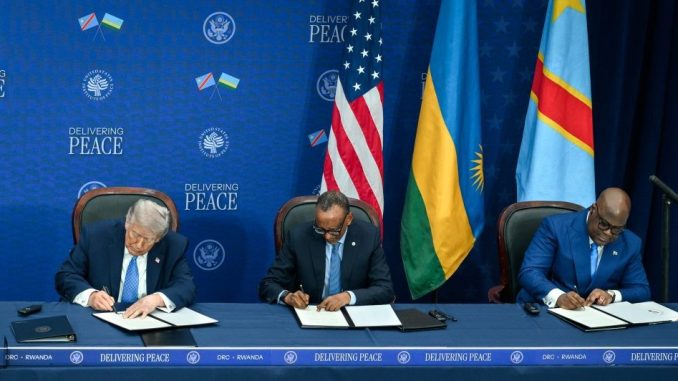
Rwanda’s actions in eastern DRC are a clear violation of the Washington Accords signed by President Trump, and the United States will take action to ensure promises made to the President are kept.
— Secretary Marco Rubio (@SecRubio) December 13, 2025
Rwanda has its own interests and security concerns in Eastern DRC, and some are likely legitimate. There are worries that when the Banyamulenge’s vulnerability is compounded in regional confrontations and war rhetoric, it tends to be diluted. Countries should restrain or be called out to stop exploiting this position to justify their actions. I argue the UNSC to establish mechanisms, UN fact-finding, to document and learn from the atrocities committed against the Banyamulenge and other minorities in Eastern DRC.
Delphin R. Ntanyoma
Twitter: https://x.com/Delphino12

Leave a Reply