
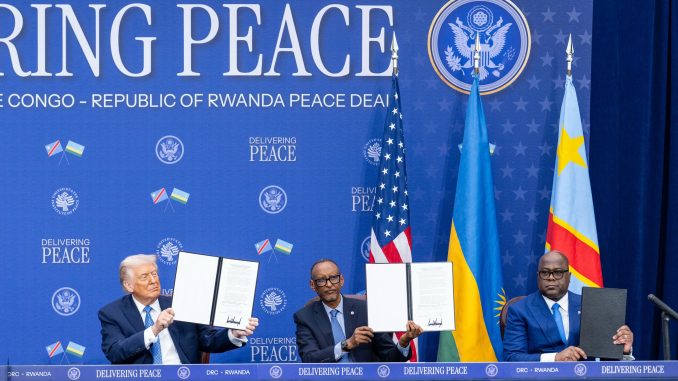
On January 22, 2026, the U.S. House Foreign Affairs Africa Subcommittee held a hearing in Washington, D.C., titled “Advancing Peace in DRC and Rwanda through President Trump’s Washington Accords.” The hearing chaired by the New Jersey Republican Rep. Chris Smith has focused on how the US oversees and implements the Washington Accords for Peace and Prosperity between the Democratic Republic of Congo (DRC) and Rwanda. The peace accord brokered by President Trump was signed in December 4, 2025. The hearing had a witness, Sarah Troutman, the Deputy Assistant Secretary for African Affairs at the U.S. Department of State.
Opening Remarks: Chairman Rep. Chris Smith
In his opening remarks, Chris Smith emphasized that this was his fourteenth hearing on the crisis between the DRC and Rwanda, underscoring long-standing violence linked to the aftermath of the 1994 Rwandan genocide and the M23 rebel insurgency. Smith described the Washington Accords as a historic achievement that could bring peace, stability, and economic opportunity to the Great Lakes region. He recalled that its implementation and compliance remain major challenges.
Rep. Smith recalled concerns raised in December of 2012, “Can the inter-ethnic problems in the DRC and its neighbors be finally resolved so that a lasting peace… can be achieved? It is time now to find a way to bring an end to the suffering.” I say again, this is the time to focus on the benefits of peace.
Ranking Member: Rep. Sarah Jacobs
As a democrat top leader within the Subcommittee, Sarah Jacobs (California’s 51st congressional district)aligned with the broader Democrat subcommittee concerns. Rep. Jacobs highlighted the need for civilians’ protection, and accountability in the implementation of the Washington accords.
For years, international responses to political violence in the DRC and Rwanda were weak and indifferent. Thanks to President Trump, the response is now strong and sustained.
Ensuring both countries uphold the Washington Accords is key to lasting peace. pic.twitter.com/Jmd5nSfXsQ
— House Foreign Affairs Committee Majority (@HouseForeignGOP) January 22, 2026
While emphasizing the immense suffering of the Congolese people, she called for serious, and concrete actions against Rwanda and M23. Rep. Jacobs highlighted reports of abductions and reprisal attacks against Banyamulenge civilians in areas like Uvira and Kamanyola following the withdrawal of M23. She rightly underscored the lack of participation and failure to include civil society organisations and local communities in setting up the peace processes.
Testimony: Sarah Troutman
In her testimony, Sarah Troutman highlighted how the Accords support U.S strategic interests by stabilizing a mineral-rich region, securing supply chains, and attracting investment, while also opportunities for the people of the DRC and Rwanda to rebuild prosperity. She acknowledged the fragility of peace and stressed that implementation remains the focus, with continued collaboration with partners — including the African Union, United Nations, and Qatar — to ensure commitments translate into tangible improvements and accountability for threats to peace.
The key highlights and statements from the hearing:
- U.S. commitment to enforcement: Troutman emphasized that the U.S. would ensure promises made to President Trump are upheld, with transparency, accountability, and consequences for its violations. She stated the U.S. would take action if commitments are not met, describing the DRC-U.S. strategic partnership as unique and beneficial for reducing reliance on China in critical minerals (e.g., cobalt for tech supply chains).
- Security concerns and mutual threats: Troutman described the Forces Démocratiques pour la Libération du Rwanda (FDLR) militia as a “legitimate threat” to Rwanda, asserting the group cannot be allowed to operate in eastern DRC.
- Critiques of implementation and violations: The implementation encountered early challenges as Rwanda and M23 breached the accords by capturing the city of Uvira days after signing the Washington accords.
- Inclusion and process concerns: Representatives and members of the subcommittee called for broader inclusion of Congolese populations and civil society organisations.
- Economic and regional cooperation: The discussions touched the importance of involving other regional countries in the peace processes and make it benefiting the African Great Lakes region including other countries such as Burundi and Uganda.
Takeaway
The United States is committed to holding both the DRC and Rwanda accountable and consequences will follow, including potential sanctions for its violations. Troutman argued that “transparency and accountability are central at every stage, and those who threaten peace will be held responsible.”Everything will be done to make sure commitments made to President Trump are upheld. Rwanda’s partial withdrawals from Uvira are not insufficient. There is a need to undertake a complete withdrawal from DRC territory for the fully respect DRC’s sovereignty and territorial integrity. The FDLR militia remains a “legitimate threat” to Rwanda and “cannot be allowed to continue operating” in eastern DRC; hence, they should be disarmed.
Delphin R. Ntanyoma
Twitter: https://x.com/Delphino12

Leave a Reply