

On March 19, 2026, the Economist media reported about the escalation of violent conflict in Fizi territory of South Kivu of the Democratic Republic of Congo (DRC). As violence moves away from media and the attention of the international community, this is a commendable effort to raise an alarm of the prevailing security climate in Fizi/South Kivu.
Two observations may help complement the reporting. First, while violence often unfolds far from cameras and media attention, it is sometimes interpreted through broader analytical frameworks that may not fully capture the lived experiences of all affected communities. Though some of them are at-risk communities, their perspectives remain difficult to access. Second, the complexity of local dynamics can occasionally lead to blurred distinctions between communities and armed actors.
The Economist Audience & Readership
Across the globe, the Economist has a very audience with 1.25 million subscriptions. Its X(Twitter) account has around 26 million of followers, LinkedIn (13 million), YouTube (482 million views). The Economist is a highly influential media with millions of readerships on weekly basis. It focuses on global politics, economics, and international affairs, with an emphasis on policy, markets, and geopolitical developments. The Economist remains strategic for it targets decision-makers, educated professionals, policymakers, academics, and business leaders as the main audience.
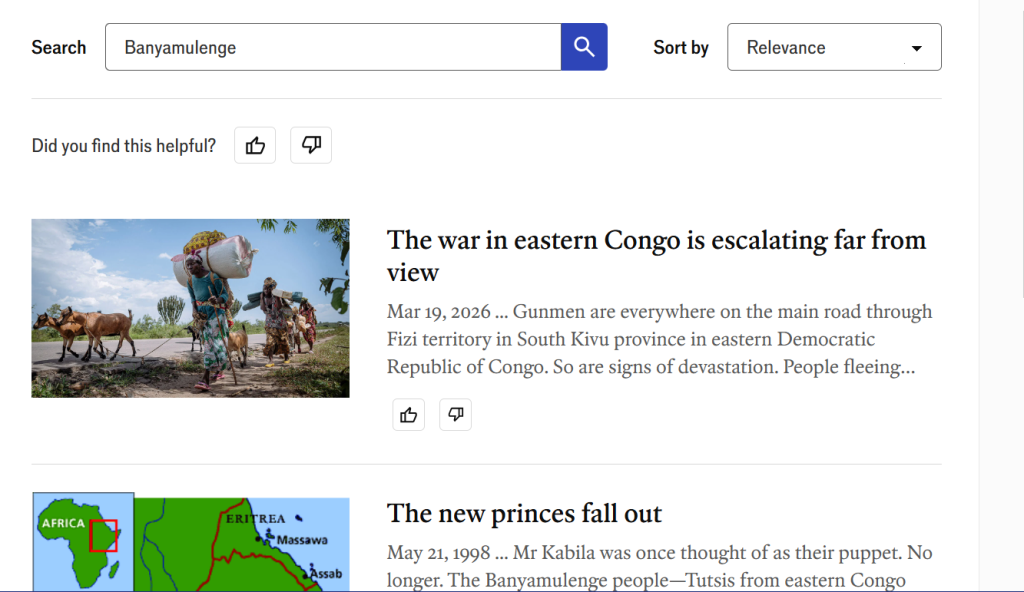
What is underreported?
Except the above-mentioned article, a quick scan of the Economist website shows that the very recent newspaper referring to the Banyamulenge (the latter used as keyword) is in 2004 (Gatumba massacre) and 1998 (the second Congo rebellion).
- Escalation of violence in Fizi and around Minembwe
The Economist’s article suggests that
“After Willy Ngoma, m23’s military spokesman, was killed in a drone strike near the mining town of Rubaya in North Kivu in February, the group’s allies in the south intensified their offensive against the Congolese army and militias allied with it.”
Recent escalation of violence in Fizi territory and around Minembwe can be situated around 2019. As rightly argued, the local security context deteriorated much following the capture of Bukavu in February 2025. As far as local sources are concerned, intense fighting in the Hauts Plateaux around Minembwe erupted following the withdrawal of M23 in the city of Uvira. Ascribing the escalation to one single party in the conflicts would need much investigation.
- Fighting to control strategic areas
The Economist’s article states that
“Whoever ends up in control of the area will have leverage over the towns on Lake Tanganyika and the road south towards Congo’s mining heartland.”
From 2017 onwards, war and violence in this region have claimed millions of civilian lives, displaced hundreds of thousands of families whose sources of livelihood and income were destroyed. Be it strategic or not, there are reasons to believe that some combatants engage to protect their communities and have no political ambitions to control cities or/and to occupy mining heartlands.
- Banyamulenge are not only seen as Rwandans
The Economist’s article argues that
“Many locals perceive South Kivu’s Tutsis, known as the Banyamulenge, as a Rwandan transplant.”
The Banyamulenge are not only perceived by locals as a “Rwandan transplant.” Independent scholarly research has also documented that certain local militias, including Mai-Mai groups—some of which now operate under the banner of Wazalendo and maintain varying degrees of alignment with the Congolese armed forces—have publicly framed their mobilisation in terms of removing in the DRC (or at least in South Kivu) what they describe as “Rwandan invaders.”
Beyond these narratives, continued violence affecting Banyamulenge communities has raised concerns about patterns of targeted insecurity and displacement, including contesting Banyamulenge’s rights to manage local entities. Such dynamics underscore the importance of carefully distinguishing between armed actors and civilian communities, and of situating local perceptions within the broader and evolving context of conflict in eastern Democratic Republic of Congo.
- “Animosity” located to the 1990s
The Economist’s article claims that
“Animosity has its roots in atrocities committed by Banyamulenge militias during the first and second Congo wars of the late 1990s and early 2000s.”
Again, locating the roots of “animosity” in the 1990s simplifies the long history of contestation and marginalisation of the Banyamulenge. There is evidence that in the 1980s, the Congolese (then Zaire) stripped officially the Banyamulenge’s citizenship. In the 1990s, prior to successive wars that involved Banyamulenge youth, the Zairean state resolved and attempted to entirely expel the Banyamulenge with an intention to send them to where they allegedly think they came from, Rwanda, Burundi and possibly Ethiopia. In October 1996, the Zairean officials ordered the Banyamulenge to leave Congo/Zaire within six days.
Beyond doubt, illustrative events shown in the previous paragraph were precedent of 1990s wars. Hundreds of militias in this region have committed atrocities against civilians. Animosity located in 1990s and around atrocities committed by the Banyamulenge militias gives a partial picture. It is less contestable that the region has more dozens of local militias and armed groups and all commit violence against civilians.
- Rwanda’s geopolitical and economic interest
The Economist’s article asserts that
“At the time, Rwanda backed the [Banyamulenge] groups to help it fight Hutu génocidaires who had fled to Congo after the genocide of Rwanda’s Tutsis.”
In terms of political choices, the Banyamulenge are not a homogenous group. Besides wishing to live safely as do many Congolese communities, members of the Banyamulenge are not all politically supportive of Rwanda’s interference in the DRC. The large majority are civilians who have nothing to do with politics.
The political and military elite is also divided. Scholarly documented findings show that some Banyamulenge military and political elite felt reluctant to follow (serve as bridge) Rwanda’s geopolitical and economic interests in the DRC. In recent years, there has been a large consensus among the elites to take distance vis-à-vis Rwanda’s interference to the extent some Banyamulenge military officers clashed with the Rwanda Defense Forces (Rwanda Patriotic Army). Banyamulenge reluctance and disagreements towards RDF/RPA have never saved them from being attacked by local MaiMai militias.
- Shifting alliance among local combatants
The Economist’s article insists that
“That dynamic [Rwanda support to Banyamulenge militias] is now playing out again.The largest Banyamulenge militia, which has its stronghold in the South Kivu highlands, officially joined forces with M23 just over a year ago”
Militias and combatants’ alliance is not static or inherently determined. What is described as Banyamulenge militia that joined M23 has been fighting to protect their relatives for roughly six years now. Evidence shows that Banyamulenge combatants fought against MaiMai local militias who allied with Burundian rebels (operated in South Kivu). They were supported or offered breaches (corridor) to attack by the Congolese armed forces (FARDC).
There are convincing reasons that Burundian rebels, namely Red-Tabara, received support from Rwandan security services. Whoever followed closely the security situation between 2017, 2017 to 2024, Banyamulenge combatants believed that Rwanda supported militias that attacked them. In 2025, the Banyamulenge combatants joined M23 and the shifting alliance invites us to closely understand the socio-security context than considering that there is some inherently static.
My latest for @TheEconomist, with reporting from Fizi, South Kivu. The scale of the humanitarian crisis is going unnoticed, given the territory’s remoteness. Thousands upon thousands of people were fleeing the highlands, carrying meagre belongings. https://t.co/Aqbsyfs0Kn
— Emmet Livingstone (@L4ingstone) March 19, 2026
What to learn?
Reporting violence taking in remote areas like Fizi and Minembwe is challenging given its accessibility and insecure environments. The challenges highlight how limited access and scarce reporting may inadvertently contribute to partial understandings of local contexts.
The Economist has consistently provided thoughtful and sustained coverage of persecuted ethnic and linguistic minorities such as the Rohingyas, Uyghurs, Yazidis, Kurds and Tigrayans to name but a few. The reporting helps bring global attention to communities whose voices are often overlooked.
Limited access to remote areas means that the perspectives of affected communities—particularly minorities such as the Banyamulenge—remain underrepresented, which can obscure how local dynamics shape the conflict. It is important to incorporate additional locally grounded perspectives could help further enrich coverage and provide a more nuanced account of how the conflict is evolving.
Delphin R. Ntanyoma
Twitter: https://x.com/Delphino12

Leave a Reply