Felipe Antonio Honorato and Guilherme Silva Pires de Freitas* argue that long-lasting stability involves transformation in social structures that generate complaints and dissatisfaction that promote the rise of non-state armed groups.
- Introduction
The rebel group March 23 (M23), which operates in the Eastern region of the Republic Democratic of the Congo (DRC/ DR Congo) has resumed its attacks and expanded its area of penetration since early October 2023 after almost ten years of inactivity.
Although not the only armed militia in the area, M23 is the most effective and well known one; its operations enjoy military and logistical support from the Rwandan army. For these reasons, the upsurge is causing a new wave of violence and displacement in both North and South Kivu.
Since the early 2000s, the Congolese government has relied on militarised solutions to try to “defeat” these rebels. But the matter is that many of them are not solely armed militias: as is the case of the M23, for example, they fight for the political and social rights of the Banyamulenges, an underrepresented Congolese Tutsi group.
The aim of this article is to discuss, observing the case of Eastern DRC, how militarised solutions have proven to be inefficient in resolving conflicts. Long lasting stability, as Duarte and Carvalho argue, involves transformation in social structures that generate complaints and dissatisfaction that promote the rise of non-state armed groups. For this, the article begins explaining the background of the last cycle of violence in Eastern DR Congo. Then, two failed militarized solutions attempts in the region are described: the United Nations Organization Stabilization Mission in the Democratic Republic of the Congo (MONUSCO) and the SADC Mission in Democratic Republic of Congo (SAMIDRC). After, it is discussed how the case of Eastern DRC shows that resolving a conflict involves transformation in social structures. The article finishes with the conclusion.
2. The last cycle of violence in Eastern DR Congo
In April 2012, the M23 rebellion began with the mutiny of approximately 600 soldiers that were part of the Congolese army, bringing a new wave of violence and destruction to the region – M23 occupied the city of Goma in eastern DR Congo (DRC) for 10 days. The rapid rise and its links to Rwanda caused alarm and triggered international efforts for a ceasefire.
The current M23 rebel group is what is left of the original M23 formed in April 2012. M23 was an offspring of the National Congress for the Defence of the People (CNDP) a rebel group which fought the DRC government between 2006 and 2009. Both groups draw on a claim that the Congolese Tutsi and other ethnic communities in North and South Kivu provinces are discriminated against – they are considered of Rwandan descent and are commonly referred to as “Rwandophones”.
After its defeat in 2013 at the hands of DRC army and United Nations (UN) troops, M23 split into two factions, which were respectively given refuge in Rwandan and Ugandan military camps. In the years that followed, the group’s current leader Sultani Makenga, then part of the faction based in Uganda, prepared the group’s reunification, and return to DRC; at the end of 2016, Makenga then moved back into DRC’s North Kivu province and set up a military base.
From November 2021 on, M23 has had an upsurge. Being considered a minor threat for almost one decade, the militia resumed its attacks and expanded its area of penetration. M23’s operations, which enjoy military and logistical support from the Rwandan army, covers a coltan-rich area, extending from Bunagana to Goma.
At the beginning of March 2024, the Congolese president, Félix Tshisekedi, and the Rwandan president, Paul Kagame, separately visited Luanda for talks with Angolan President João Lourenço, whom the African Union (AU) has designated to mediate between the two countries. In December 2024, the peace talks were cancelled over disagreements about M23. Rwanda had insisted on direct dialogue between DRC and M23, which the Congolese government refused.
In January, 2025, M23 took control of eastern DRC’s largest city, Goma, home to more than 2 million people. In February, 2025, the rebel group took control of the South Kivu province capital, Bukavu, and in March, 2025 they seized the mining hub Walikale, also in North Kivu.
In late March 2025, Congo’s government and M23 rebels held private talks in Qatar for the first time since the rebels conducted the offensive. Kinshasa and the M23 planned to hold the direct talks on April 9, 2025, but the process was advanced. This prompted the M23 to withdraw from Walikale as a goodwill gesture.
In December 2025, the “Washington Accords for Peace and Prosperity” were signed in Washington D.C. (USA). It was mediated by the United States and aimed for peace in the region. However, fighting in Eastern Congo persists, as does the humanitarian crisis forcing the mass exodus of civilians. A January 2025 report by the United Nations High Commissioner for Refugees (UNHCR) counted 237,000 forcibly displaced people in the early part of that year alone due to the intensification of fighting in the provinces of North and South Kivu.
Beyond territorial disputes, excessive violence, and mass displacement, the conflict also presents an economic dimension, as it involves control of strategic mineral resources and regional interests linked to the exploitation and export of these riches. The North and South Kivu region concentrates large mineral reserves, especially of coltan, which is essential for the global technology industry. Control of areas like Rubaya, abundant in coltan production, by the M23 allows the group to tax production, regulate trade routes, and control local extraction within transnational supply chains, sustaining an economy of war through revenues derived from minerals.
The geostrategic component of the conflict must be highlighted too: among other points, the Kivus region border three countries (Burundi, Rwanda and Uganda), being very important for security matters; Goma has the biggest airport in the region and the only one able to receive large aircrafts; and Uvira is in a crossroad that links the South Kivu and Bujumbura, the capital of Burundi.
There is also the primarily geopolitical and diplomatic activity of foreign powers in the region, such as China and the United States. Both have interests in the local mineral wealth, compete for influence over the supply chains of these minerals, and seek stability to achieve their objectives.
Finally, it’s important to clarify that although M23 is the most effective and well known insurgent group operating in the Kivus, it is not the sole armed militia active in the region – there are more than hundreds of them, formed by various motivations. The Forces Démocratiques de Libération du Rwanda (FDLR), for example, is formed by servicemen of the defeated Hutu-led Rwandan government that had committed genocide against Tutsis and moderate Hutus in 1994. They withdrew to the Congo, where they found some safe place from attacks by Rwandan forces and its allies. The Congolese government has been helping FDLR following the logic that “the enemy of my enemy is my friend”.
3. MONUSCO and the failure of militarized solutions in the region
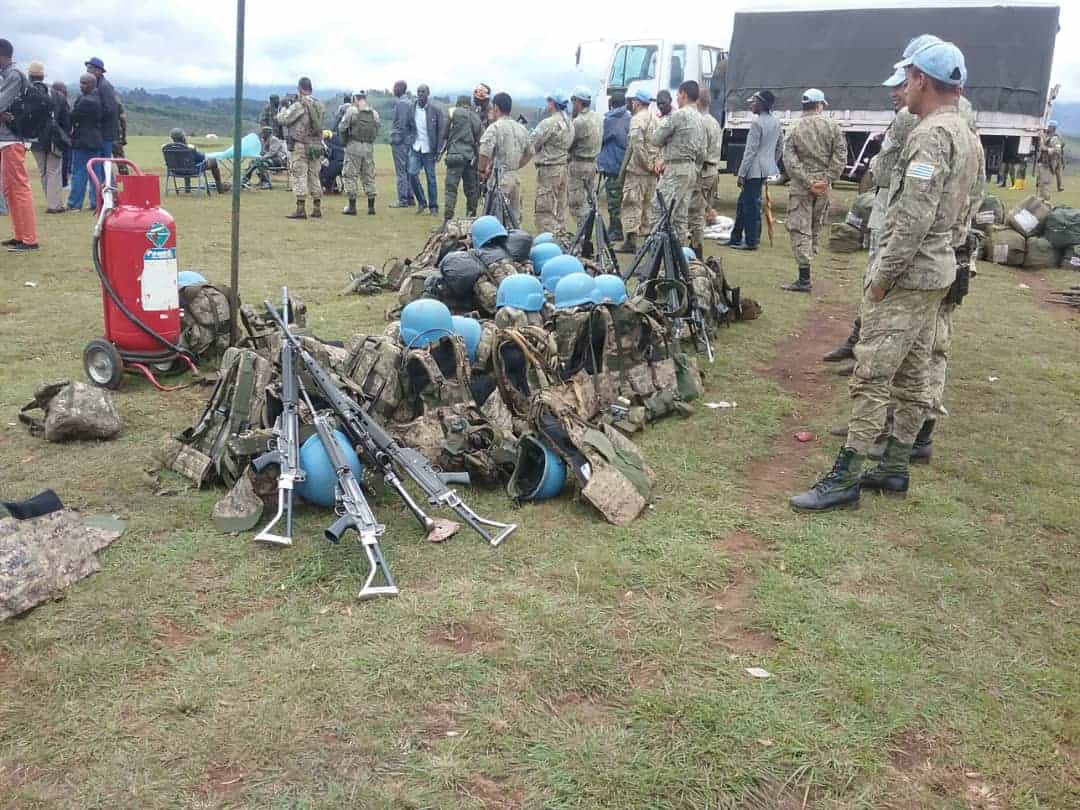
The UN peacekeeping mission in eastern Congo – the United Nations Organization Stabilization Mission in the Democratic Republic of the Congo (MONUSCO) has been present in the DRC since 1999 (during the Second Congo War). Around 2023, it counted with 16,000 officers and had an annual budget of 1 billion US Dollars, but currently, although MONUSCO has had its mandate extended until December 20, 2026 by the UN Security Council, the troop was limited to 11,500 military personnel and 600 military observers.
The fact is that MONUSCO is suffering from a lack of trust by the Congolese. Albeit having a big budget and a long presence in the terrain, it has been repeatedly accused of failing to protect civilians and some MONUSCO’s bases were looted. Along with this lack of trust, the UN peacekeeping operation seems to be making the Congolese government reluctant to apply durable solutions with the actors involved in the conflict – i.e. hearing and dealing with political and social demands made by the insurgent groups.
The MONUSCO mandate has the primary objective of supporting the government, seeking to reestablish state authority. The peacekeeping mission is authorized to use force in self-defense and in defense of its mandate. This new format of operations reproduces the intervention model adopted by the United States in Afghanistan and Iraq, in the context of the war on terror, and aims to contain violent conflicts by neutralizing non-state actors who do not enjoy international credibility and do not have their objectives considered legitimate, such as the M23.
Because the mandate contains clear objectives related to supporting the established government to stabilizing the territory, and resorting to the robust use of force, in practice, the mission would end up giving the government a military victory. However, from the point of view of resolving the armed conflict, this may not be ideal, as it imposes a peace process that does not necessarily accommodate the interests of the parties involved. Without addressing the causes of the armed conflict and the commitment of the parties to the process, there is no solid prospect for long-term peacebuilding.
4. The SADC Mission in Democratic Republic of Congo (SAMIDRC): another failure of militarized solutions in the region
South Africa, Tanzania and Malawi, who formed SAMIDRC, deployed to eastern DRC in late 2023, replacing the East African Community Regional Force (EACRF) which had been deployed in late 2022. Less than six months into EACRF’s mandate, the Congolese government had fallen out with EAC member states over the exact nature of the force mandate: Kinshasa argued that EARCF troops should be going after the M23, while the EAC argued that its troops were there to safeguard areas that had been recaptured by the Congolese army. Also, the Congolese President Félix Tshisekedi was demanding the EAC to put pressure on Rwanda over its support for the M23.
The EACRF was asked to leave and Tshisekedi successfully made the case that the DRC needed military support from the Southern African Development Community (SADC), lobbying especially with South Africa. On March 13, 2025, however, SADC decided to withdraw the SAMIDRC force from the eastern DRC after the fall of Goma city in the hands of M23. This was because of the lack effectiveness of the mission and the military superiority of M23.
During the first year of its deployment, SAMIDRC proved unable to make a difference on the battlefield. The M23 expanded its territorial control by 30% between January and December 2023, while SAMIDRC troops remained in the area of their headquarters in Sake, near Goma, the provincial capital of North Kivu. In addition, the Congolese army was an unreliable partner, which could neither contain nor push back the M23: as Stephanie Wolters explains, “Many of its commanders have links to various armed groups or are involved in the illicit minerals trade, while FARDC troops are notorious for committing human rights violations. As the M23 advanced on SAMIDRC headquarters and towards Goma, many FARDC soldiers simply fled”.
Also, the M23 constantly targeted SAMIDRC in the battlefield, with a focus on South African troops. SAMIDRC troops repeatedly came under heavy enemy fire, both from across the Congolese border and from M23 positions in North Kivu and in January 2025 14 South African service personnel were killed.
5. “Resolving a conflict involves transformation in social structures”
Resolving a conflict involves transformation in social structures that generate complaints and dissatisfaction that promote the rise of non-state armed groups. Therefore, spending time and financial resources in militarized solutions without addressing dissatisfactions and establishing a peaceful arrangement that promotes overcoming violence, there will hardly be an effective resolution of the conflict.
The political agreement that ended M23’s occupation of Goma more than a decade ago was never fully implemented. Its combatants should have been integrated into the Congolese national army but were not. Furthermore, the M23 political wing was to become a recognised political party but that partially happened. The DRC government, first under President Joseph Kabila and now President Félix Tshisekedi, opted to politically engage its main sponsor, Rwanda, formally or informally.
While some posited that Kabila used the threat of armed militias to boost his own political position (as long as the threat was not against the government itself in Kinshasa, it aided Kabila by pointing to a threat to rally support), Tshisekedi compared Rwanda’s President Paul Kagame to Adolf Hitler during the 2023 electoral campaign. He predicted Kagame would meet the same fate as the Nazi leader and promised that, if re-elected, he would declare war on Rwanda and march on its capital. According to the Crisis Group staff, journalists and Congolese analysts, this nationalist positioning likely helped him to win re-election.
Also, the situation of the Banyamulenge must be observed. The M23 was formed by former members of armed groups such as the CNDP and PARECO (Patriotes Résistants Congolais), many of them integrated into the Armed Forces of the Democratic Republic of the Congo (FARDC) after the 2009 peace agreement, who defected and became leaders of a mutiny, alleging not only non-compliance with the terms of the peace agreement, but also that they had received inadequate treatment by the army. According to M23 leaders, the group’s return would be an attempt to force the government to comply with the clauses of the peace agreement signed after the 2013 surrender.
One of the grievances of the M23 speaks to the segregation of Tutsis among other ethnic groups in eastern DRC. Herbert Weiss explains that interethnic relations in the Kivus have, for many years, been more problematic than in most other parts of the DRC. This is probably due to three underlying factors: the coexistence of pastoralists and sedentary farmers; a higher than usual population density; and a cultural divide between the “original sons” of the land and the Kinyarwanda-speaking immigrants – both Hutu and Tutsi – who migrate west from Rwanda and Burundi. Some of these migrations occurred hundreds of years ago, while others date back to contemporary times.
In this regard, Verweijen et al. state that members of self-styled autochthonous groups present in the region, such as the Babembe, Bafuliiru and Banyindu, consider the Banyamulenges “foreign”, especially those from recent migrations: they would not be “authentically Congolese” and, therefore, would not have land rights, citizenship and local authority functions. More moderate voices even recognize that the Banyamulenges have lived on Congolese soil for a long time, but do not see them as capable of occupying roles related to traditional authorities and owning ancestral lands. According to Congolese laws, only people belonging to groups that own ancestral lands are “authentically Congolese”, that is, possessing Congolese citizenship “by origin” (nationalité d’origine).
Conclusion
Addressing the dissatisfactions of all parts involved in the conflict and establishing a peaceful arrangement seems to be the best way for a lasting solution for the cycles of violence that has been taking Eastern DRC since the 1994 Rwandan genocide. In this regard, the political agreement that ended M23’s occupation of Goma more than a decade ago must be fully implemented.
In the same direction, showing serious commitment to deal with the Banyamulenge situation in the Kivus could leave the M23 without one of its main arguments for engaging in the fights and undermine its support within these marginalized groups in the Congolese society. There is a very urgent need for this tutsi social group living in the DRC to be recognized as full Congolese citizens.
It’s also important to keep the presence of any other international or multinational force in the DRC limited, otherwise MONUSCO will be replaced by another militarized approach. As discussed, the UN stabilization mission in the DR Congo is the longest and the most expensive in the organization’s history, but had almost no concrete outcome – the M23, for example, stayed as a minor threat for around a decade, but now is experiencing a very strong upsurge. The rebel group even inflicted a military defeat to the SADC Mission in Democratic Republic of Congo (SAMIDRC), killing 14 South African soldiers.
Finally, the UN is considering redeploying MONUSCO in South Kivu to monitor the ceasefire established by the “Washington Accords for Peace and Prosperity“. But it seems that the force won’t be effective once again.
Multilateralism and the United Nations are facing a strong crisis. Besides the fact that tensions among major powers have repeatedly foiled diplomacy at the Security Council, with the return of Donald Trump to the American presidency in 2025, the U.S., the organisation’s single largest donor, has cut large tranches of funding for the UN and its agencies. The country has also quit a raft of multilateral agreements, pursuing unilateral peace initiatives with little reference to the United Nations.
With this scenario in mind, there are questions that arise about the capability of the UN for serving as monitor in South Kivu in this historic moment: Will the UN have enough financial resources to keep MONUSCO operating? Will the parties involved and the international community consider the UN a trusted monitor? Will the Congolese population consider the UN a trusted monitor?
*About the authors:
Felipe Antonio Honorato (Brazil) is a PhD in Social Change and Political Participation by the University of São Paulo, Brazil. Honorato is currently a professor in the Postgraduate Program in African Studies and Representations of Africa (PPGEARA — Universidade do Estado da Bahia, Brazil) and a Postdoctoral researcher in Universidade Estadual do Centro Oeste (Brazil).
Guilherme Silva Pires de Freitas (Brazil) is a PhD in Social Change and Political Participation by the University of São Paulo, Brazil. Freitas is currently a professor in the Postgraduate Program in Social Change and Political Participation (PROMUSPP) and a Postdoctoral researcher in the University of São Paulo (Brazil).
Felipe Antonio Honorato & Guilherme Silva Pires de Freitas have also published another argument about conflict in the astern Congo that can be found here: Banyamulenge citizenship in DRC is at the heart of the recent conflict.
Leave a Reply